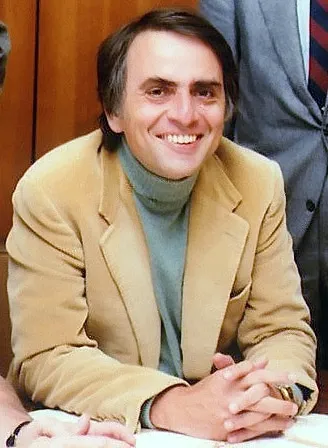
Carl Sagan was born in New York in 1934 and died in 1996. He was an astronomer, a teacher and a researcher, but above all he was someone determined that science should not stay locked in laboratories.
In 1978 he won the Pulitzer Prize for The Dragons of Eden, and soon afterwards came Cosmos, the 1980 book written alongside the television series of the same name, which brought the birth of stars and of life into millions of homes. In Broca's Brain he gathered essays on science and reasoning; in Pale Blue Dot he started from a photograph of the Earth taken from very far away to talk about our place in the universe.
The Demon-Haunted World, from 1995, may be his most necessary book: a defence of critical thinking and a small toolkit for telling what we know from what we would like to believe.
Their books in our catalogue
B
CosmosCarl Sagan
CosmosCarl Sagan
Cosmos
Carl Sagan
Carl Sagan traces the story of the universe alongside the story of the people who tried to understand it, from ancient Alexandria to the spacecraft that reached neighbouring planets. Stars, cells, galaxies and the search for life elsewhere come together in a lucid, generous narrative. Reading it feels like being guided by someone whose wonder is utterly contagious.
Affiliate links: if you buy through them, MyBibliotype may earn a small commission at no extra cost to you. How affiliate links work
B
The Demon-Haunted WorldCarl Sagan
The Demon-Haunted WorldCarl Sagan
The Demon-Haunted World
Carl Sagan
Carl Sagan lights a candle against easy belief, showing how the scientific method works and why skeptical thinking belongs to everyone, not just scientists. From witch hunts and faith healers to UFOs and alien abductions, he teaches readers to tell testable claims from seductive ones. Warm, lucid and strikingly timely, it makes a passionate case for reason as a guardian of freedom.
Affiliate links: if you buy through them, MyBibliotype may earn a small commission at no extra cost to you. How affiliate links work
B
Pale Blue DotCarl Sagan
Pale Blue DotCarl Sagan
Pale Blue Dot
Carl Sagan
Taking the famous Voyager 1 portrait of Earth as a tiny speck in the dark as his starting point, Carl Sagan tours the solar system and asks what our place in the cosmos really is. It reads like a warm, wondering conversation, mixing science with philosophy and closing on a hopeful case for humanity's future among the stars.
Affiliate links: if you buy through them, MyBibliotype may earn a small commission at no extra cost to you. How affiliate links work
B
Broca's Brain: Reflections on the Romance of ScienceCarl Sagan
Broca's Brain: Reflections on the Romance of ScienceCarl Sagan
Broca's Brain: Reflections on the Romance of Science
Carl Sagan
Carl Sagan gathers essays first written in the 1970s for a wide range of magazines, and together they form a tour of science at its most wondrous: the cosmos, the human mind, the edges of knowledge and the line between inquiry and wishful belief. It reads like an evening with a passionate, clear-eyed and often witty guide who makes you want to keep asking questions.