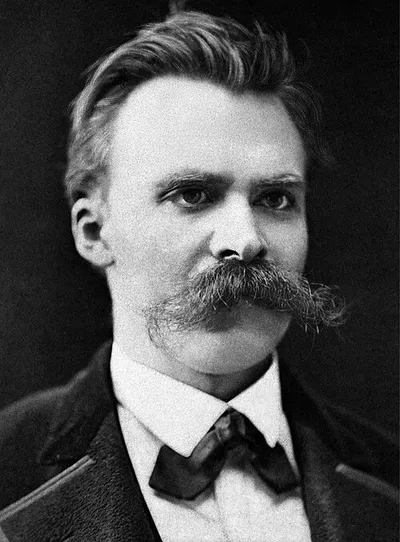
Photo: Friedrich Hermann Hartmann · Dominio público · Source
Author
Friedrich Nietzsche
1844–1900
Friedrich Nietzsche was born in 1844 in a village in Saxony and died in Weimar in 1900. He was a brilliant student of classical philology, so much so that the University of Basel gave him a chair before he had turned twenty-five. Years later he left the university and spent a decade travelling between Switzerland and Italy, writing without pause.
From that period comes Thus Spoke Zarathustra, whose last part was published in 1885: a book halfway between philosophy and poetry, in which a solitary prophet comes down from the mountain to announce uncomfortable ideas about morality, will and how to live. Ecce Homo, written in 1888, is an intellectual autobiography full of irony and pride.
Nietzsche writes in aphorisms, fragments and sentences that land like blows. You don't need to agree with him to enjoy him; you only need to let yourself be provoked.
Their books in our catalogue
B
Thus Spoke ZarathustraFriedrich Nietzsche
Thus Spoke ZarathustraFriedrich Nietzsche
Thus Spoke Zarathustra
Friedrich Nietzsche
After long years alone in the mountains, a prophet comes down to speak about God, morality, suffering and the chance of a different kind of human being. Nietzsche turns his philosophy into parables, songs and sermons with a scriptural ring, closer to poetry than to argument. It rewards slow reading, pencil in hand, letting each image unsettle your own assumptions.
Affiliate links: if you buy through them, MyBibliotype may earn a small commission at no extra cost to you. How affiliate links work
B
Ecce Homo: How One Becomes What One IsFriedrich Nietzsche
Ecce Homo: How One Becomes What One IsFriedrich Nietzsche
Ecce Homo: How One Becomes What One Is
Friedrich Nietzsche
Nietzsche puts his own life on trial, revisiting his childhood, his tastes and each of his books with brazen wit and biting irony. Behind chapter titles like "Why I Am So Wise" lies an intense, defiant self-portrait. A short, dizzying, passionate read that works as a personal doorway into his whole philosophy.
Affiliate links: if you buy through them, MyBibliotype may earn a small commission at no extra cost to you. How affiliate links work
B
The Will to PowerFriedrich Nietzsche
The Will to PowerFriedrich Nietzsche
The Will to Power
Friedrich Nietzsche
Assembled after Nietzsche's death from his notebooks, this collection was arranged by his sister Elisabeth and Peter Gast under a title he had once planned to use. Reading it feels like stepping into a philosopher's workshop: short, charged fragments on values, morality and the drive at the heart of life. A book for readers who like their ideas restless and provocative.